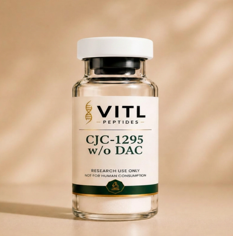
CJC-1295 without DAC is a synthetic peptide associated with research into growth hormone-releasing hormone (GHRH) signaling. It is commonly discussed in peptide research because its molecular design differs from the DAC-modified form, affecting how researchers distinguish between compounds with related names. Understanding these differences is important when evaluating peptide identity, pharmacological properties, available evidence, and product documentation.
Researchers reviewing the CJC-1295 without DAC peptide should pay particular attention to the exact molecular form being described. Similar product names do not guarantee identical structures, pharmacokinetic properties, or research findings.
This article examines the scientific background of CJC-1295 without DAC, compares it with the DAC-modified form, and explains the documentation and regulatory considerations relevant to research compounds.


What Is CJC-1295 Without DAC?
CJC-1295 without DAC is generally used to describe a modified GHRH-related peptide without the Drug Affinity Complex modification associated with the longer-acting form of CJC-1295. However, peptide naming in commercial listings is not always consistent, making it essential to verify the stated molecular structure and specifications.
An Introduction to Growth Hormone-Releasing Hormone Analogues
Growth hormone-releasing hormone is a naturally occurring hormone produced in the hypothalamus. It signals the anterior pituitary gland to release growth hormone, which contributes to several physiological processes, including growth, tissue maintenance, and metabolic regulation.
Synthetic GHRH analogues are designed to interact with this signaling system. Their structures may be modified to influence receptor activity, stability, or duration of action. These properties depend on the specific peptide sequence and any additional chemical modifications.
CJC-related peptides are discussed in research involving the regulation of growth hormone release. Nevertheless, a compound’s relationship to a natural hormone does not automatically establish its effectiveness or safety as a treatment.
Understanding the Meaning of DAC
DAC stands for Drug Affinity Complex. In the DAC-modified form of CJC-1295, this modification is designed to promote binding to albumin, a protein that circulates in the blood. Albumin association can extend the compound’s presence in circulation and influence its pharmacokinetic profile.
The form commonly described as CJC-1295 without DAC lacks this specific modification. It is often associated with the name modified GRF (1-29), although commercial terminology may be inconsistent. Researchers should verify the actual sequence and structure rather than assuming that all products sold under these names are equivalent.
Why Product Terminology and Molecular Identity Matter
Peptide names can reflect a research convention, a shortened product label, or a specific structural description. These labels may not provide enough information to confirm the exact material supplied.
Molecular identity affects how a compound should be characterized and how published findings should be interpreted. If the sequence, modifications, or formulation differ, evidence relating to one material may not apply to another.
Accurate identification is therefore a fundamental part of reproducible research and responsible documentation.
How Does CJC-1295 Without DAC Differ From CJC-1295 With DAC?
The primary distinction between these forms concerns the DAC modification and its effect on pharmacokinetics. Although the compounds are discussed in relation to GHRH signaling, their molecular characteristics and duration of action should not be treated as interchangeable.
Understanding the Drug Affinity Complex Modification
The DAC modification in CJC-1295 is designed to facilitate albumin binding. Because albumin remains in circulation for an extended period, this association can slow the clearance of a peptide and prolong its exposure.
The non-DAC form does not contain the same albumin-binding modification. Its behavior in the body is therefore different, and its stability and duration of action must be assessed independently.
These structural differences are important when comparing experimental findings, interpreting pharmacological data, or reviewing a product’s stated specifications.
Differences in Molecular Design and Pharmacological Duration
A peptide’s molecular design influences its interaction with biological systems, susceptibility to degradation, and movement through the body. Adding a chemical modification may change these properties even when the underlying peptide is related to the same biological pathway.
The DAC-modified form was developed to extend exposure, while the non-DAC form is generally described as having a shorter duration. The precise pharmacokinetic characteristics depend on the material studied and the conditions under which it is evaluated.
Researchers should rely on relevant analytical and pharmacological evidence rather than assuming a specific duration based on a product name alone.
Why Product Names Alone Cannot Verify Compound Identity
Commercial listings may use related names for different peptide forms. A title that includes CJC-1295 does not necessarily reveal whether DAC is present, whether the sequence matches the intended compound, or whether the material contains additional modifications.
Reliable evaluation requires a clear molecular description, appropriate analytical testing, and batch-specific documentation. These records help establish what was tested and whether the material corresponds to the intended research specification.
What Is the Scientific Background of CJC-1295?
CJC-1295 is associated with research into the GHRH pathway, which plays a central role in the regulation of growth hormone secretion. Understanding this pathway provides context for why synthetic analogues are investigated and why their effects require careful evaluation.
The Role of Growth Hormone-Releasing Hormone in Physiology
GHRH is produced in the hypothalamus and acts on receptors in the anterior pituitary. Activation of these receptors stimulates the release of growth hormone, a process regulated by multiple signals rather than a single hormone alone.
Growth hormone secretion is influenced by factors such as age, sleep, metabolic state, and other hormonal signals. Its release also occurs in pulses, which complicates the interpretation of measurements taken at isolated time points.
These physiological characteristics matter when researchers assess compounds intended to affect growth hormone signaling.
Research on Growth Hormone Signaling
Growth hormone acts on tissues throughout the body and contributes to growth, protein metabolism, and the regulation of other metabolic processes. Some of its effects involve insulin-like growth factor 1, commonly known as IGF-1, which is produced largely in the liver but also in other tissues.
Research into GHRH analogues may investigate hormone concentrations, receptor-related responses, and changes in relevant biomarkers. Such measurements help characterize biological activity, but they do not independently demonstrate a beneficial clinical outcome.
The effects of altering growth hormone signaling must be considered within the wider endocrine system, including potential effects on glucose regulation and other physiological processes.
Distinguishing Mechanistic Knowledge From Evidence of Clinical Benefit
A plausible mechanism can explain why a peptide is worth investigating, but it cannot establish that the compound is effective or safe for a particular purpose. Biological activity, clinical efficacy, and long-term safety are separate questions.
Evidence must be evaluated according to study quality, population, treatment conditions, and measured outcomes. Claims about improvements in body composition, recovery, or general well-being should not be treated as established simply because a compound is associated with growth hormone signaling.
What Does Research Establish About CJC-1295 Without DAC?
The available evidence for CJC-related compounds varies by formulation and research context. Findings concerning the DAC-modified form should not automatically be applied to the non-DAC form, particularly when pharmacokinetic behavior and molecular design differ.
Available Pharmacological Research
Scientific interest in CJC-related peptides centers on their relationship to GHRH signaling and the potential to influence growth hormone secretion. Pharmacological investigations can examine molecular properties, receptor-related activity, peptide stability, and changes in hormone measurements.
However, evidence for one CJC-related formulation may be more developed than evidence for another. Researchers should identify the exact compound used in each study before drawing conclusions about its findings.
Commercial descriptions and informal reports are not substitutes for peer-reviewed research or appropriately controlled clinical trials.
Limitations in Human Safety and Efficacy Evidence
Evidence about the safety and effectiveness of CJC-1295 without DAC in humans remains limited. A lack of robust clinical evidence makes it difficult to establish appropriate uses, long-term risks, or the balance between potential benefits and adverse effects.
Changing growth hormone signaling may have consequences beyond the intended biological response. Potential concerns include effects on glucose metabolism, fluid balance, and other endocrine processes. The significance of these risks depends on the compound, exposure, and individual circumstances, and cannot be determined from product descriptions alone.
Why Findings From One Formulation May Not Apply to Another
Different formulations may vary in albumin binding, degradation, circulation time, and overall exposure. These differences can affect both the magnitude and duration of biological effects.
Results obtained with DAC-modified CJC-1295 therefore cannot automatically establish the pharmacology or safety of CJC-1295 without DAC. Researchers should confirm the formulation, review the study methods, and avoid generalizing beyond the evidence.
What Should Researchers Check When Evaluating CJC-1295 Products?
Research quality depends on more than a product’s advertised name. Documentation should help establish the material’s identity, analytical characteristics, traceability, and storage requirements.
For product information and research-compound listings, Vitl Peptides provides a website where available product details can be reviewed. A commercial listing should still be assessed independently, and availability does not establish suitability for human use.
Confirming the Exact Molecular Form
Specifications should clearly identify whether the peptide is the non-DAC form or the DAC-modified form. Relevant details may include the stated amino acid sequence, molecular modifications, molecular mass, and other defining characteristics.
If the product description uses multiple names, the documentation should clarify how those terms relate to the material supplied. Ambiguity about the molecular form can undermine the interpretation and reproducibility of research.
Reviewing Analytical Testing and Certificates of Analysis
A certificate of analysis, or CoA, summarizes testing performed on a material. Researchers should review whether the certificate identifies the specific batch, states the analytical methods used, and provides results against defined specifications.
High-performance liquid chromatography may help assess chromatographic purity, while mass spectrometry can support molecular mass and identity assessment. These techniques provide different types of evidence and should be interpreted according to their limitations.
A reported purity percentage alone does not establish sterility, clinical safety, or regulatory authorization.
Assessing Batch Identification and Product Traceability
Batch or lot identification connects a product to its manufacturing and testing records. Traceability makes it possible to determine whether analytical results apply to the material under review.
Documentation should be consistent across the product label, certificate of analysis, and relevant records. Missing or mismatched batch information makes independent verification more difficult.
Understanding Stability and Storage Documentation
Peptide stability can be affected by temperature, moisture, light, formulation, and storage duration. Appropriate documentation should explain the conditions under which the material is expected to retain its specified characteristics.
Researchers should review available stability data and handling instructions before designing experiments. They should not assume that a peptide remains unchanged after inappropriate storage or outside the conditions supported by its documentation.
What Are the Safety and Regulatory Considerations?
Peptides that influence endocrine pathways require careful evaluation because hormonal systems regulate multiple physiological processes. Research availability should not be confused with authorization for medical use.
Potential Concerns Associated With Experimental Growth Hormone Modulators
Compounds that alter growth hormone signaling may affect more than one biological endpoint. Changes in hormone concentrations can interact with glucose regulation, fluid balance, and other endocrine functions.
The absence of sufficient clinical evidence means that the frequency, severity, and long-term implications of potential adverse effects may not be fully characterized for CJC-1295 without DAC. It is therefore inappropriate to infer safety from its peptide structure or its relationship to a naturally occurring hormone.
Understanding Research-Only Labeling
Research-only labeling indicates that a product is being marketed for research purposes rather than as an authorized medicine for human treatment. Such labeling does not independently verify identity, purity, manufacturing quality, or experimental suitability.
Research compounds should not be treated as interchangeable with regulated pharmaceutical products. Claims about human benefits require appropriate evidence and cannot be established by online availability.
Checking Current Regulatory Status and Applicable Restrictions
Regulatory status can differ by country and may change as new evidence becomes available. Researchers should consult relevant health authorities for current information on authorization, restrictions, and applicable requirements.
Before relying on a product for any purpose, it is important to distinguish the status of the specific compound from that of related peptides or formulations. Medical decisions should be based on authorized treatments and qualified healthcare guidance, not solely on research listings.
Frequently Asked Questions
What Does DAC Mean in CJC-1295?
DAC means Drug Affinity Complex. In the modified form of CJC-1295, it is designed to promote albumin binding and extend the compound’s circulation time.
Is CJC-1295 Without DAC the Same as CJC-1295 With DAC?
No. The forms differ in molecular modification and expected pharmacokinetic properties. Researchers should confirm the exact structure because findings from one form may not apply to the other.
Why Is Molecular Identity Important in Peptide Research?
Molecular identity helps establish whether the material being studied matches the intended compound. Differences in sequence or chemical modification can affect stability, biological activity, and the interpretation of research results.
Does Research Availability Establish Human Safety?
No. A product being available for research does not establish that it is safe or effective for human use. Those conclusions require appropriate evidence and, where applicable, regulatory authorization.
What Should a CJC-1295 Product Specification Include?
Useful specifications should identify the exact molecular form, relevant sequence or structural details, batch number, analytical testing methods, results, and storage or stability information. These details support traceability but do not by themselves establish clinical safety.
Conclusion
CJC-1295 without DAC is associated with research into GHRH signaling and growth hormone regulation. Its distinction from the DAC-modified form is important because differences in molecular design can influence pharmacokinetics and the relevance of published findings.
Reliable evaluation requires accurate compound identification, appropriate analytical testing, batch-specific records, and a clear understanding of the limitations in human safety and efficacy evidence. Researchers should avoid treating commercial terminology as proof of molecular identity or assuming that findings from one formulation apply to another.
For additional company information, visit the About us page. Ultimately, sound peptide research depends on transparent documentation, careful interpretation of evidence, and a clear distinction between investigational compounds and authorized medical treatments.