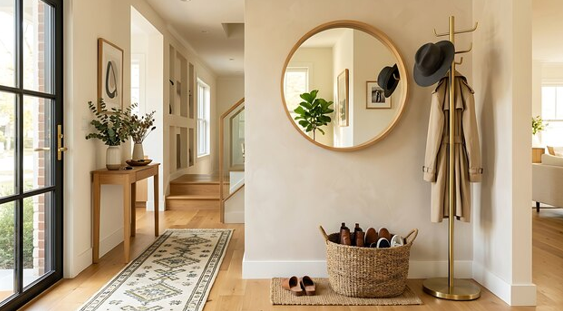
The entrance hallway often has limited space, yet it sets the visual tone for the rest of a home. A well-positioned mirror can make this area feel brighter, more open, and more considered without taking up floor space. Mirrors for hallway entrance areas can also serve a practical purpose, giving residents a convenient place to check their appearance before heading out. The right size, shape, and position can make a noticeable difference to an otherwise overlooked part of the home.
Start With the Hallway Layout
A hallway mirror should work with the dimensions and movement of the space. Narrow entrances need careful planning because a mirror that extends too far from the wall may interfere with people walking through the area.
Before choosing a design, look at the wall where the mirror will be installed and consider nearby doors, furniture, switches, and storage. A clear section of wall usually provides the best location.


Measurements should include:
- Available wall width
- Ceiling height
- Distance from doors
- Position of nearby furniture
- Walking clearance
- Location of switches and lights
These details help determine whether a horizontal, vertical, or full-length mirror is appropriate.
See also: A Practical Guide to Choosing Comfortable, Secure Dentures for a Confident Smile
Use Reflection to Add Depth
Hallways can sometimes feel enclosed because of their narrow proportions. A mirror can create the impression of additional depth by reflecting part of the room.
The reflected area matters just as much as the mirror itself. A mirror facing a window may bring reflected daylight into the hallway, while one facing a decorative feature can give that feature more visual presence.
A cluttered view, however, can have the opposite effect. Before installation, stand where the mirror will be positioned and consider what it will reflect. This simple check can prevent an attractive mirror from highlighting an untidy area.
Choose a Shape That Suits the Entrance
The shape of the mirror can influence the overall character of the hallway. Rectangular designs are practical for narrow walls and can provide a clean, structured appearance. Round and oval mirrors introduce softer lines, which can balance entrances containing angular furniture or architectural features.
Arched mirrors can add a more distinctive profile, while unusual geometric designs can work as decorative features in contemporary interiors.
The surrounding details can guide the choice:
- Curved furniture can pair well with rounded glass
- Straight cabinetry can suit rectangular designs
- Decorative wall panels can work with framed mirrors
- Minimal interiors may suit simple frameless glass
- Traditional entrances may benefit from decorative frames
There is no need for every feature to match exactly. A few related shapes or finishes can be enough to make the space feel connected.
Consider a Mirror Above a Console
A console table beneath a mirror can create a practical entrance arrangement. The table provides a place for keys, mail, or small decorative objects, while the mirror occupies the wall above it.
Proportion is particularly important in this arrangement. A mirror that is significantly narrower than the console can look disconnected, while an excessively wide design may overwhelm the furniture.
Leave enough space between the tabletop and the bottom of the mirror. This keeps the arrangement visually balanced and provides room for lamps, decorative objects, or everyday items.
Full-Length Mirrors Have Practical Value
A full-length mirror can be useful near an entrance because it allows a person to check an entire outfit before leaving. It can be mounted vertically on a wall or positioned on a suitable door or wardrobe surface, depending on the home’s layout.
A full-length design can also draw the eye upwards, making a low-ceilinged or narrow hallway appear taller. Its position should not reduce the available walking area.
For busy entrances, secure mounting is particularly important. The mirror should remain stable when people pass close to it or use nearby doors and storage.
Frameless Glass Creates a Clean Appearance
Frameless mirrors can suit hallways where the goal is to keep the wall visually light. Without a decorative border, the reflection becomes the main feature, allowing the mirror to blend with surrounding colours and finishes.
Framed mirrors provide more visual definition. A timber frame can complement wooden furniture, while a metal frame can relate to handles, lighting, or other hardware.
Frame thickness should correspond with the size of the mirror. A heavy frame may dominate a small entrance, while a very narrow frame may not provide enough definition on a large wall.
Lighting Can Change the Effect
Natural and artificial lighting both influence how a hallway mirror looks. A mirror placed near a window can reflect daylight, making the entrance feel brighter during the day.
Artificial lighting needs similar consideration. Wall lights positioned near the mirror can provide useful illumination, while overhead lighting may create reflections that affect visibility.
Before installing the mirror, check:
- Direction of natural light
- Position of ceiling lights
- Nearby wall lighting
- Reflections from glass doors
- Visibility at night
- Potential glare
A well-lit mirror is more useful and can contribute to the overall appearance of the entrance.
Keep Furniture and Decor Proportionate
A mirror does not need to stand alone. It can be paired with artwork, shelving, plants, a console, or a small seating area. The main consideration is visual balance.
Too many objects around a mirror can make a narrow entrance feel crowded. A simpler arrangement often allows the reflection to remain the main visual feature.
Colour also matters. A mirror frame that relates to existing furniture can tie the arrangement together without requiring identical finishes throughout the space.
Installation Requires More Than Positioning
A mirror may look simple, but larger pieces require careful handling and secure mounting. The type of wall, mirror weight, dimensions, and fixing method all affect the installation.
Luxurious Glass LLC can assist with residential mirror projects where accurate measurements and suitable installation methods are required. Proper fitting helps keep the mirror level and securely attached while reducing the chance of damage caused by unsuitable hardware.
For heavier mirrors, the wall structure should be assessed before installation. Different wall materials may require different fixing methods, particularly where the mirror is large or positioned in a busy entrance.
Keep the Surface Looking Clear
Hallway mirrors are handled and touched regularly, especially in homes with children or busy entry areas. Fingerprints, dust, and marks can quickly become visible on a large reflective surface.
Cleaning does not need to be complicated. A soft, non-abrasive cloth and suitable glass cleaner can help maintain a clear finish. Avoid harsh materials that may scratch the surface.
It is also useful to keep excess moisture away from the mirror edges. Regular, gentle cleaning is generally preferable to aggressive scrubbing after marks have accumulated.
Let the Entrance Guide the Choice
The most suitable mirror depends on the hallway itself. A narrow entrance may benefit from a tall design, while a wider foyer can accommodate a large horizontal mirror above a console. Lighting, furniture, wall space, and everyday movement all deserve consideration before the final choice is made.
A mirror can provide a useful finishing touch without demanding major changes to the entrance. Contact us today to discuss your mirror requirements and find an option that suits your hallway’s dimensions, layout, and existing interior.

