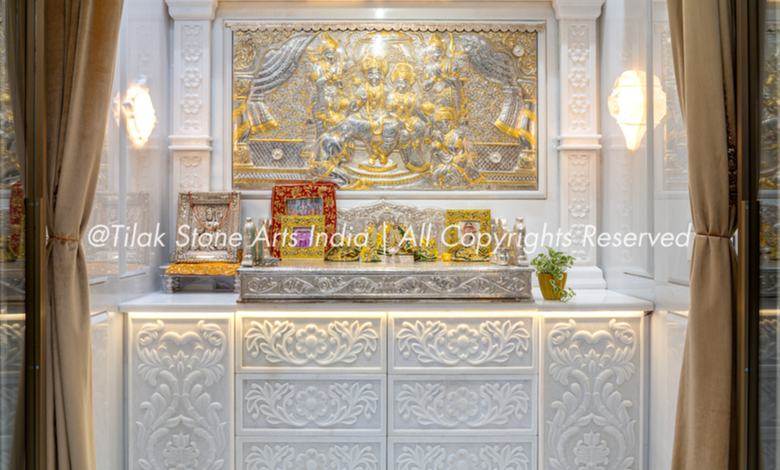
Anyone shopping for a white marble temple eventually notices something strange. Two mandirs sit side by side, same size, same white Vietnam marble, same price bracket, and one of them looks alive while the other looks flat. The carving depth is usually the reason. Undercut carving is the technique behind that difference, and it is also why good temples take weeks rather than days. Most buyers never hear the term until they have already paid for something shallow.
Here is why it matters so much. Surface carving scratches a pattern into stone. Undercut carving removes material from behind the pattern, so the design lifts away from the background with real air behind it. That gap is what creates a shadow. Shadow is what makes a white marble temple read as sculpture rather than a decorated slab.
What Undercut Carving Actually Means in Marble Temple Work
Picture a lotus petal carved on the base of a mandir. In shallow work, the petal is a groove. You can run your finger over it and feel a dip, nothing more.


In undercut work, the artisan cuts sideways and inward beneath the petal edge. The petal now stands proud, with hollow space behind it. Light passes over the top and drops into that hollow. You get a dark line under the petal that follows the curve.
That dark line is the whole point. The marble is white. White surfaces flatten under most home lighting. Without deep shadow, carving disappears from three feet away.
Undercut work shows up in a few places on a temple:
- Pillar capitals and their leaf detail
- Jali screen bars, where each strand needs to look separate
- Kalash and dome edges
- Arch spandrels above the deity seat
- Chain links and bell forms carved from a single block
Why White Vietnam Marble Handles Deep Carving Better
Not every stone survives this treatment. Undercutting weakens the material by design. You are deliberately leaving thin sections unsupported.
White Vietnam marble, sometimes sold as Swiss white marble or super fine white Vietnam marble, has a tight, even crystal structure. Fewer natural fault lines run through the block. That matters when an artisan is cutting a two millimetre bridge behind a flower.
Softer or more porous stone chips at the exact moment the undercut breaks through. The artisan loses hours of work in one second. On a large temple, that failure can cost days.
The tight grain also holds a crisp edge. Carve a sharp petal tip in poor stone, and the tip crumbles slightly, giving you a rounded, mushy line. The same cut in super-fine white Vietnamese marble remains sharp enough to catch light along its full length.
Where the Weeks Actually Go
People assume machines do this now. Some roughing work is machine-assisted, and that part is fast. The undercutting is not.
Roughing the form. The block is reduced to the broad shape. Days, not weeks. This part looks dramatic and finishes quickly.
Establishing relief. The artisan sets how far each element will stand out. Get this wrong, and there is no room left to undercut later. There is no adding stone back.
Cutting behind the design. This is the slow stage. Small chisels, angled entry, constant checking. An artisan might spend a full day on one pillar capital. On a temple with eight pillars, that alone is more than a week.
Cleaning the hidden faces. The back of an undercut is barely visible, and it still gets finished. Rough hidden surfaces catch dust and hold lamp residue. Skipping this is a common shortcut.
Final polish. Polishing an undercut area cannot be done with a machine head. It is hand work, into every hollow.
You are looking at four to eight weeks of carving on a mid-sized mandir, sometimes longer. That may sound excessive. It is simply what hand undercutting costs in time.
See also: 15 Proven Customer Retention Strategies
How to Spot Real Undercut Work Before You Buy
This is worth knowing, because photographs hide everything. A shallow carving photographed under harsh angled light looks identical to deep work.
Try these checks instead:
- Slide a thin card or your fingernail behind a carved element. Real undercut work has a gap. Shallow work stops dead.
- Look at the piece under a flat, overhead light. Shallow carving vanishes. Deep carving still shows shadow.
- Walk to one side and watch the shadows shift. Undercut shadows move. Painted or shallow detail stays static.
- Check the back faces of jali screens. Finished hidden surfaces signal careful work.
Ask how many days went into carving alone. A vague answer usually means the work was outsourced to whoever quoted lowest.
Next Steps When Comparing Temples
Ask what stone is being used, and ask specifically. For temples, white Vietnam marble and its variants reliably hold undercut detail. Pooja rooms allow for greater flexibility, including Indian wonder white marble, various Italian marbles, and onyx, since the structural demands differ from those of a carved mandir.
Then ask about carving depth in millimetres, not in adjectives. Ask which elements are undercut and which are surface relief. A serious workshop answers both questions without hesitation.